
USHJA Wheeler Museum
Show Jumping Hall of Fame: Legends and Traditions
Just a year away from the 40th anniversary of the founding of the Show Jumping Hall of Fame, the Wheeler Museum’s current exhibit showcases treasures from the Hall of Fame’s permanent collection as well as the USHJA’s own collection of memorabilia honoring the careers of Hall of Fame inductees.
The Mission of the Hall of Fame
The Hall of Fame was established as a nonprofit organization in 1987 with the mission “to promote the sport of Show Jumping and to immortalize the legends of the men, women, and horses who have made great contributions to the sport.”
Through the influence of Elizabeth Busch Burke, legendary horsewoman, owner, sponsor of Show Jumping events, and a founding board member, the Hall of Fame formally opened in 1989 at Busch Gardens in Tampa, Florida. Its displays were intended “to encourage broader interest and participation in the sport, and to educate both the equestrian and the non-equestrian by sharing the sport's lore, fundamentals, history, and greatest achievements.”
In 2010, the Hall of Fame’s collection of memorabilia moved from Busch Gardens to the Wheeler Museum in time for that year’s World Equestrian Games held in the Kentucky Horse Park. The display plaques honoring each inductee were relocated to the Rolex Stadium, with plaques for recent inductees added each year since then.
Highlights from the Current Exhibit
A particularly fun feature of the exhibit is the inclusion of some original artifacts displayed in 1989 at Busch Gardens. Check out the stories from “then and now” to trace signature trends and traditions in American Show Jumping.
U.S. Show Jumpers Are Stars of the 1984 Los Angeles Olympics
The U.S. won its first Show Jumping Team Gold at the 1984 Los Angeles Olympics. Joe Fargis also won Individual Gold, and Conrad Homfeld won Individual Silver. Fargis and Homfeld placed their medals in the Hall of Fame collection in 2012 “so that they would be a part of ongoing national history.”
The photo from the Wheeler Museum's Tish Quirk Photography Collection captures the team's excitement of standing on the Olympic medal podium. (L-R) Joe Fargis, Leslie Burr Howard, Conrad Homfeld, and Melanie Smith Taylor.
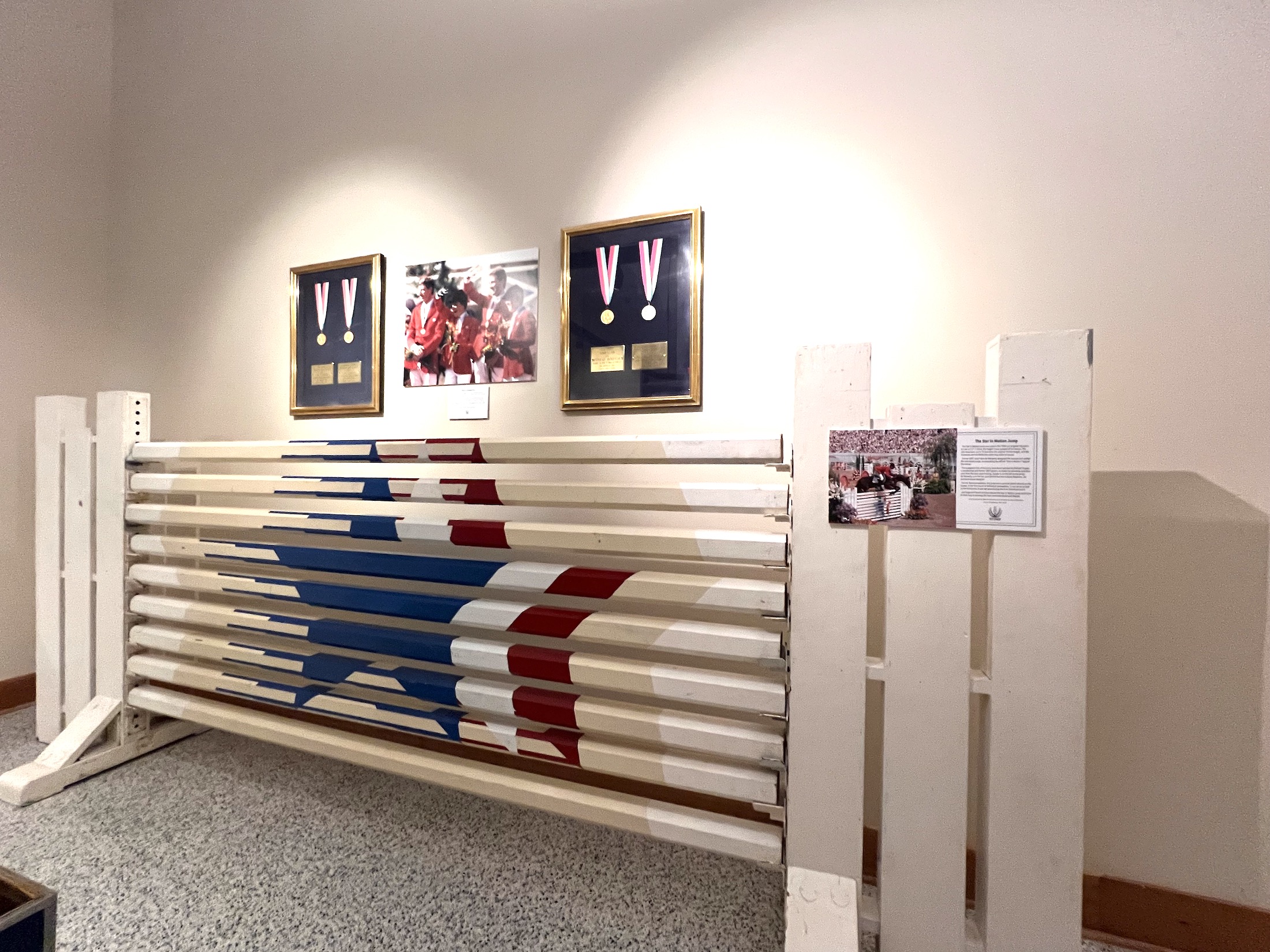 The Star in Motion jump is from the 1984 Olympics. Former USET coach Bert de Némethy designed the courses and crafted the individual obstacles, working the official “Star in Motion” logo of the Games into this unique jump. When the jumps went up for sale after the Olympics, de Némethy acquired the Star in Motion for Gene Mische, who founded Stadium Jumping and the American Grandprix Association. Steve Stephens, de Némethy's Olympic assistant course designer and the primary course builder and designer for Stadium Jumping, eventually had possession of the jump. In 1989, Stephens donated it to the Hall of Fame to serve as a highlight of the display at Busch Gardens.
In the current exhibit, the jump is set at 5’3” (1.50m), the height it was jumped at the Games. The rails were originally 16 feet long but have been cut to 10 feet, and the standards are two-thirds the original width. The heavy octagonal rails were hand-painted by Michael Snyder, a woodworker and former USET groom, to make the red-white-and-blue stars look like they were moving. A photo of Gold Medalist Joe Fargis and Touch of Class clearing the Star in Motion hangs on the jump's right standard.
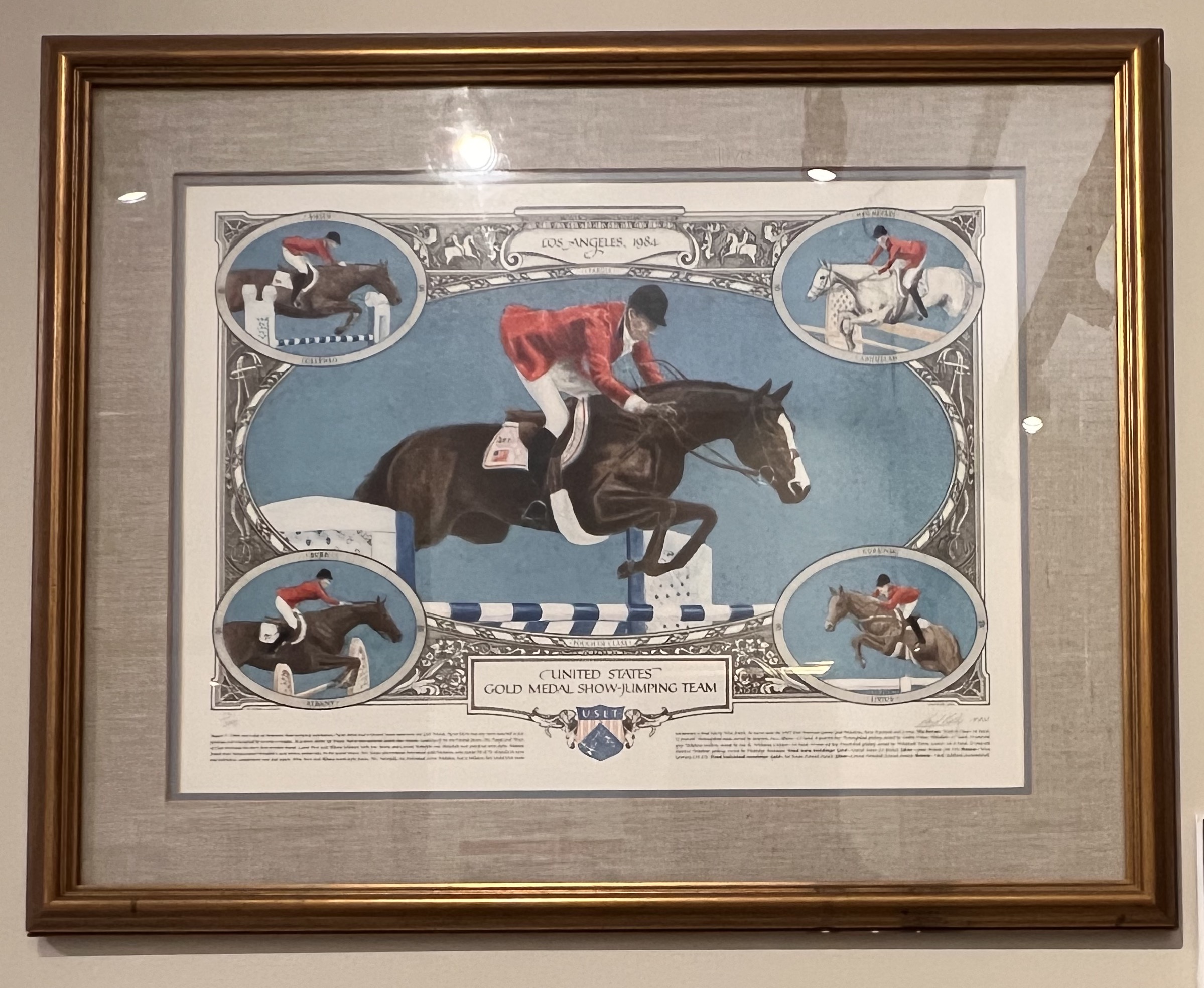
This lithograph on display was created to commemorate the 1984 U.S. Olympic Team. In the center is Joe Fargis on Touch of Class. Clockwise from upper left is Melanie Smith Taylor and Calypso, Conrad Homfeld and Abdullah, Anne Kursinski and Livius, the reserve horse-and-rider, and Leslie Burr Howard on Albany.
The lithograph is from the Wheeler Museum's Lita “Squeaky” Wangensteen Collection. The artwork in the print is by Lloyd Kelly, the calligraphy by Marjorie Corbett. This print is one of a limited edition of 375 prints by George C. Miller and Son, New York.
Honoring U.S. Olympic History
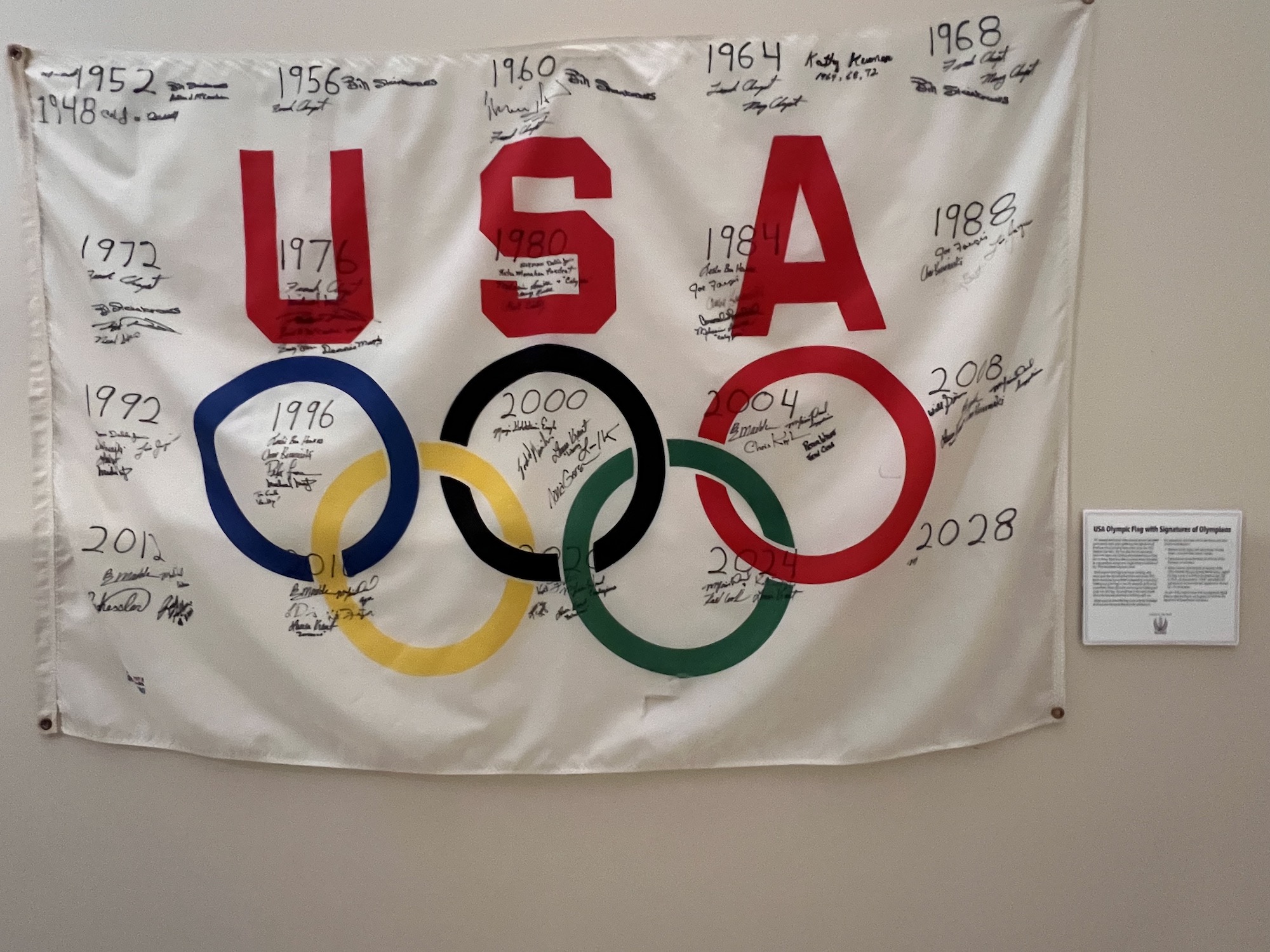 Fédération Équestre Internationale (FEI) Show Jumping steward and Hall of Fame board director Dan Reed spent nearly eight years gathering the signatures of American Show Jumping team riders since the 1952 Helsinki Olympics, the first after the U.S. Equestrian Team had taken over fielding international teams from the U.S. Army. Reed was able to contact every Olympian, or a descendant, except one: Hugh Wiley, a member of the 1956 Stockholm Olympics team.
Reed acquired the flag from Karen Golding, who came upon the discarded flag at the end of the 2015 North American Young Riders competition in Kentucky. Golding was also a steward at major international shows and had hung the flag on her FEI steward’s golf cart as a sunshield. Reed offered to sew a tarp for Golding and swap it for the flag. The tear in the fabric shows where the flag was attached to Golding’s golf cart.
Reed loaned the flag to the Hall of Fame in 2025 and plans to take it to the 2028 Los Angeles Olympics to add that team's signatures.
Inspiration for All Ages
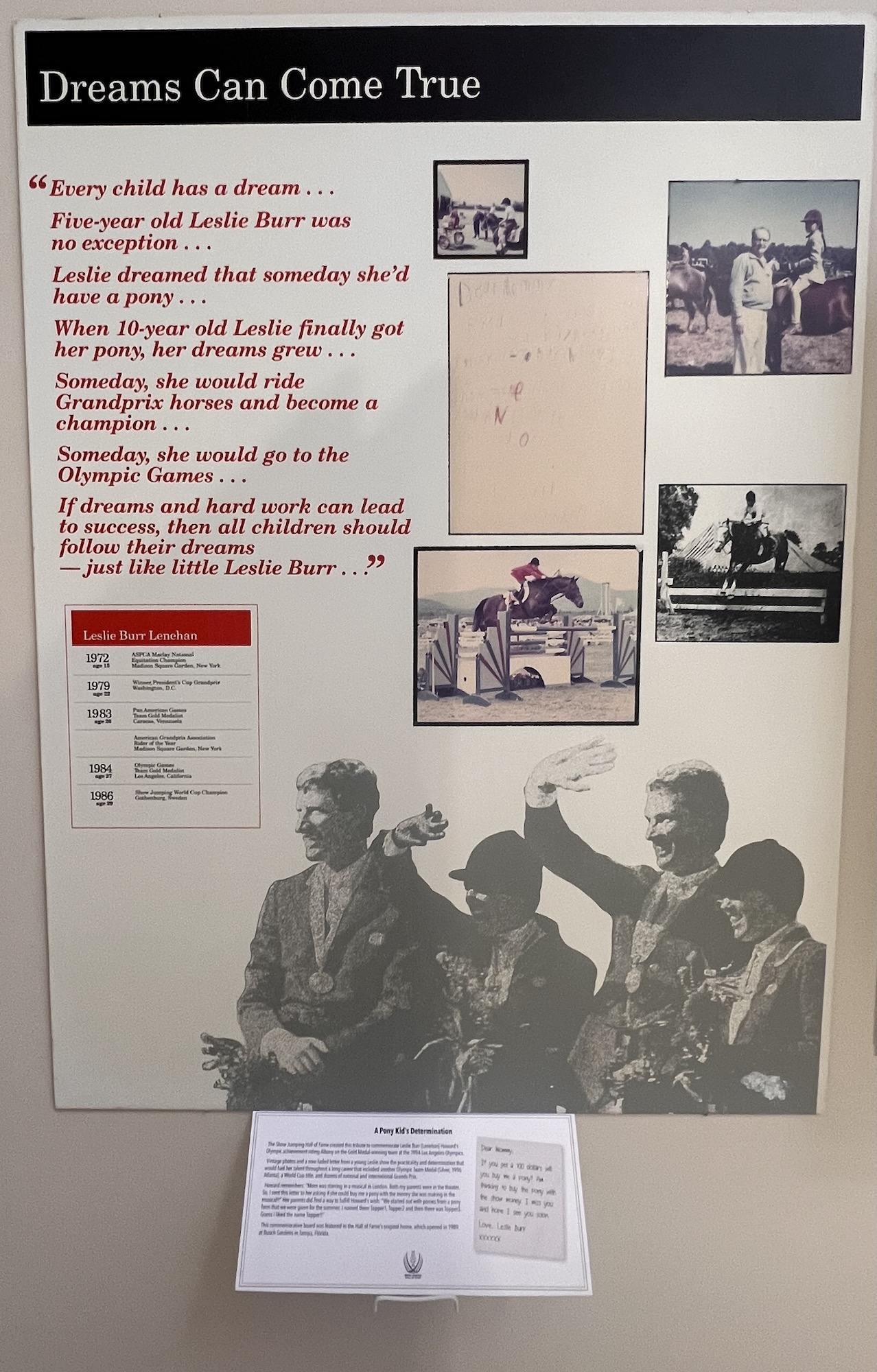 The 1989 Hall of Fame exhibit at Busch Gardens featured a tribute to Leslie Burr Howard’s achievement riding Albany on the Gold Medal-winning team at the 1984 Los Ange
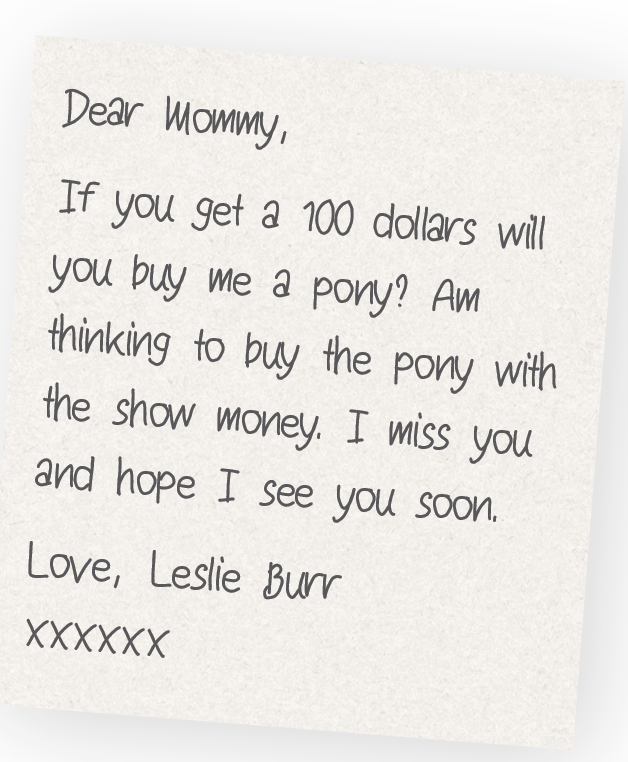 les Olympics.
Vintage photos and a now-faded letter from a young Leslie show the practicality and determination that would fuel her talent throughout a long career that included another Olympic Team Medal (Silver, 1996 Atlanta), a World Cup title, and dozens of national and international Grands Prix. The current exhibit includes the contents of the letter.
It worked, and pony after pony soon arrived.
Trading Pins, Making Friends
It’s a tradition at Olympic and other international games to trade and collect souvenir pins. Karen Golding, the first groom inducted into the Hall of Fame, accumulated an enormous collection of pins over her long tenure as groom, U.S. Equestrian Team barn manager, and Fédération Équestre Internationale (FEI) steward.
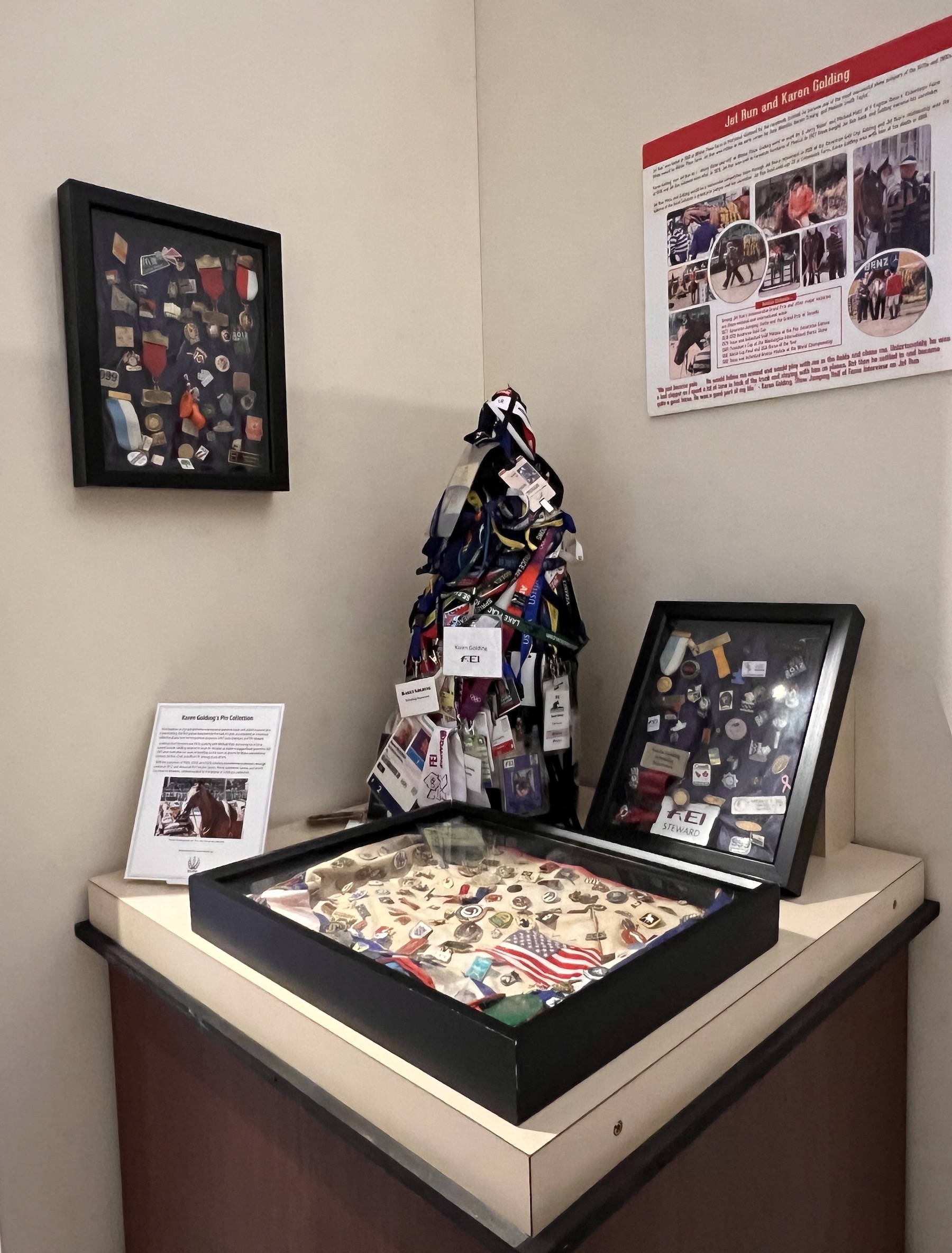 As a thank-you for supporting one another at international events, souvenir pins became a kind of currency. “The U.S.E.T. would give us a bunch of pins to hand out to break the ice when meeting new people back in the stables,” Golding said. “When someone helped us out, we gave them a pin. The pins often meant more to them than payment.”
Golding’s first Olympics was 1976, working with Michael Matz and caring for a horse named Grande. Golding went on to serve for decades as stable manager/head groom for the USET tours even after her years of traveling as groom for Matz’s international partners Jet Run, Chef, and Rhum IV, among others, ended.
With the exceptions of 1984, 2004, and 2008, Golding attended every Olympics through London in 2012, and almost all the Pan-Am Games, World Equestrian Games, and World Cup Finals in between.
When Golding passed away in 2023, she left her pin collection and a magnum draped with her horse show credentials to the Hall of Fame.
The Evolution of Grand Prix Prize Money
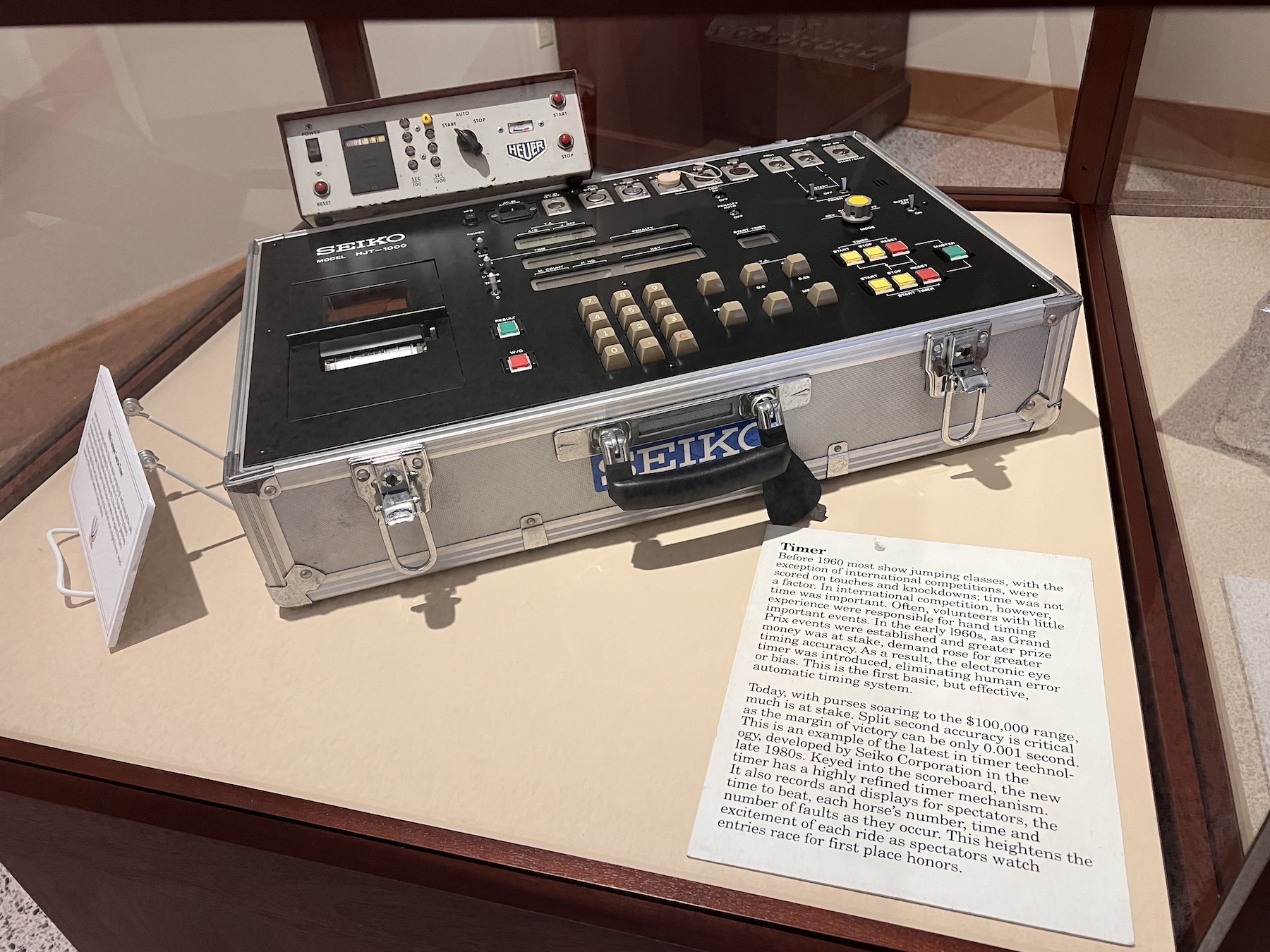
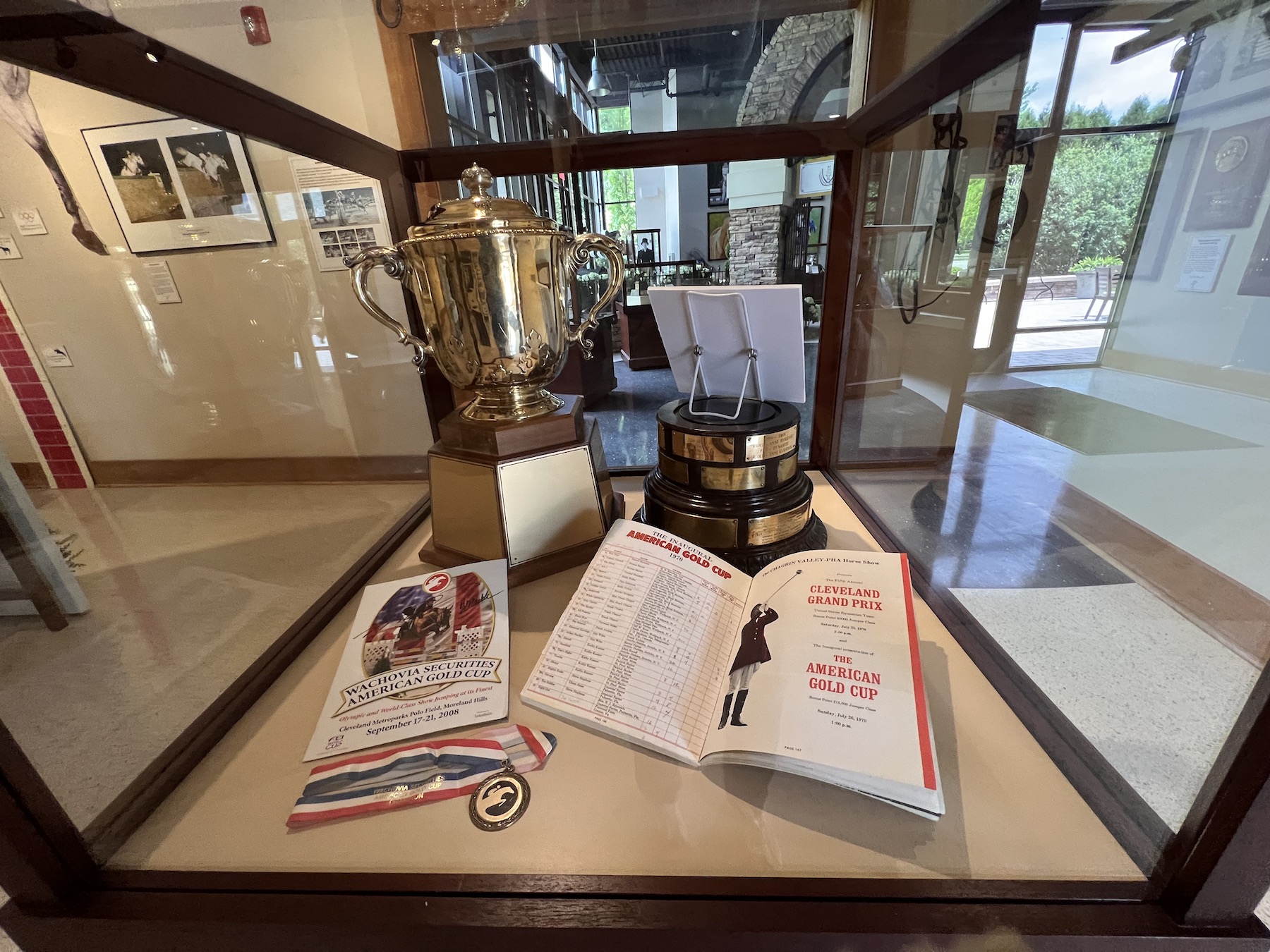
The 1970 program for the inaugural American Gold Cup shows it offered $15,000, the richest Grand Prix purse at the time. That was three times the $5,000 awarded by the prestigious Cleveland Grand Prix, the first European-style Grand Prix hosted in the U.S., then in its fifth year and held that same weekend.
The 1989 original Hall of Fame display card for the Seiko electronic timer used at premier Grand Prix events like the Gold Cup called it “the latest in time technology” to replace handheld stopwatches because “with purses soaring to the $100,000 range, much is at stake. Split second accuracy is critical.”
In 2025, the American Gold Cup awarded a purse of $340,000, and today we have become familiar with some Grand Prix classes offering prize money between $1 million and $3 million.
The Legendary Idle Dice and Rodney Jenkins
Rodney Jenkins and Idle Dice are among the most dynamic horse-and-rider combinations in American Show Jumping history. Their record-setting career for the time included winning the American Gold Cup three times, the President’s Cup at the Washington International twice, and the American Invitational among their 31 Grand Prix victories. They also won many Puissance events—one fall season jumping more than 7 feet at Washington, New York, and Toronto—while also winning Grand Prix classes. Idle Dice was the inaugural equine inductee in the Hall of Fame in 1987.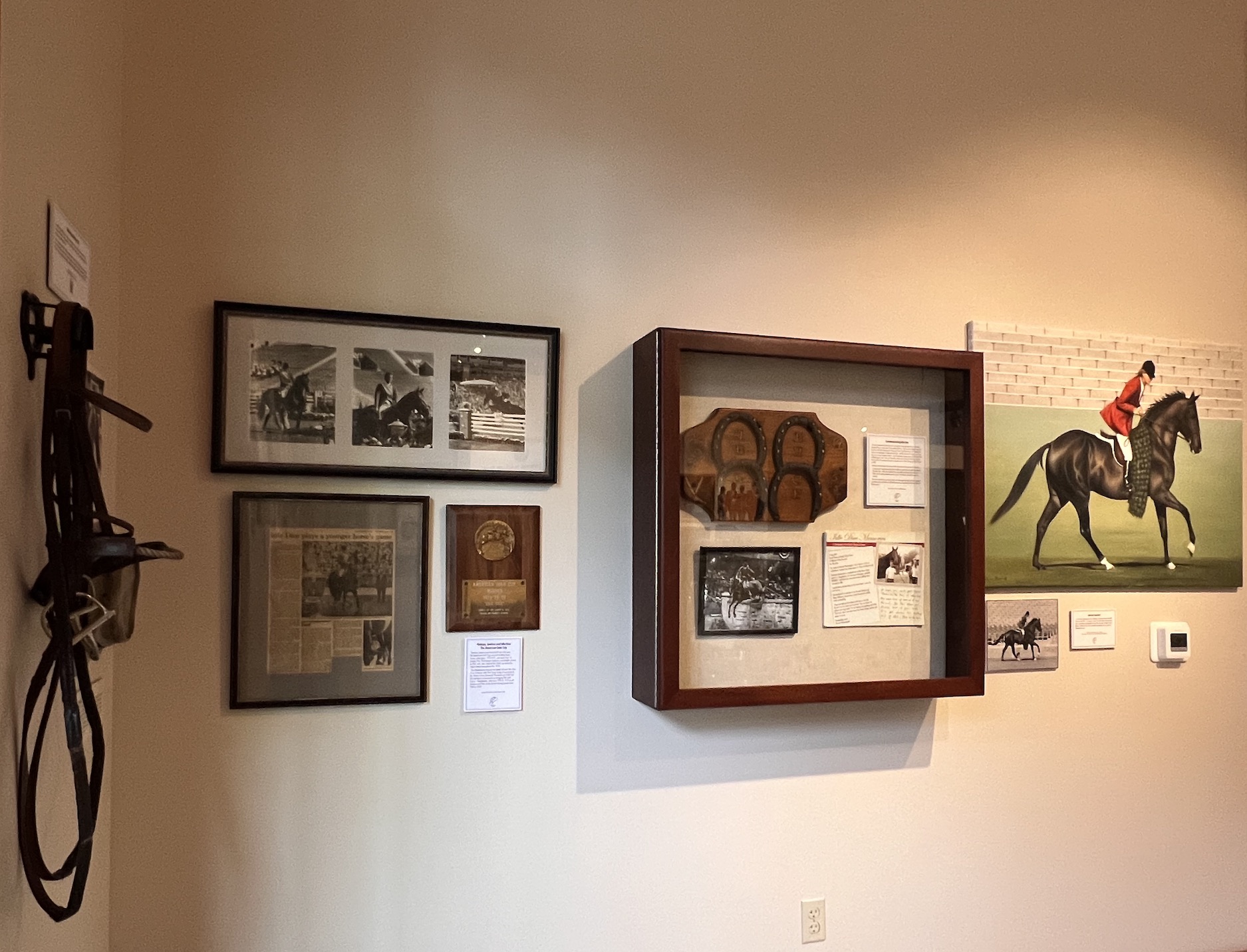
In Rodney Jenkins's own words:
"It’s really hard to describe just what a special horse Idle Dice was. In my opinion, however, there’s never been, nor is there likely to be, another one like him!
In my career I was fortunate to have ridden an awful lot of really nice horses, but Idle Dice, or Ike as we called him, was without question the nicest of them all. Ike really showed me the ropes. I’d have to say that he was my mentor.”
Items commemorating their career include:
- Idle Dice’s bridle donated by owner Harry Gill for the 1989 Hall of Fame display at Busch Gardens
- Harry Gill’s trademark hat, worn at almost every horse show he attended, loaned by Sherry Robertson Gill
- A triptych by Karl Leck and a plaque honoring Idle Dice's American Gold Cup wins in 1973-1975, along with a Philadelphia Inquirer article heralding Gill and Idle Dice as local heroes with their long string of successes at the Devon Horse Show and the American Gold Cup, loaned by Sherry Robertson Gill
- A set of Idle Dice’s shoes and a heartfelt letter donated by his farrier Vincent Mastrangelo
- A photo of Idle Dice and Rodney Jenkins during their victory gallop after winning the 1972 Los Angeles Grand Prix at the Rose Bowl from the Wheeler Museum’s Katey Barrett Photography Collection
- A painting based on Barrett’s photo created and donated by Unjin Jenkins
A Victorian Horse Exerciser
Riding horses as a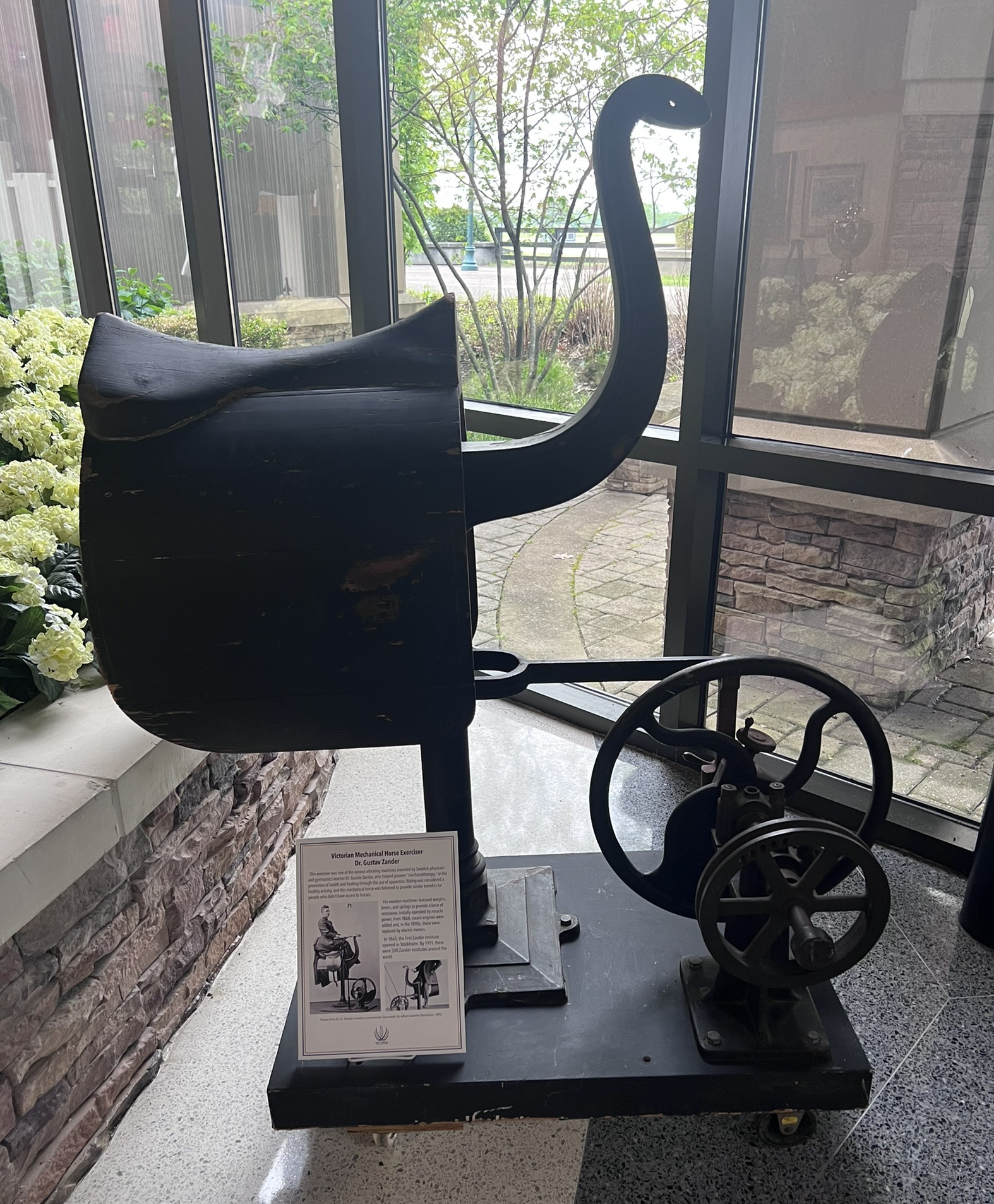 healthy activity--rather than for transportation, sport, or recreation--became fashionable in the 1860s. For those who didn't have a horse or couldn't get to one, they could try a "horse exerciser" that was a part of a famous series of gym machines created by Swedish physician and gymnastics teacher Dr. Gustav Zander.
Advertisements read: "For those who are unable – or who don’t dare – to get up on horseback, this apparatus vibrates the rider’s body."
Initially operated by the user's own muscle power, steam engines were used by 1868, which were then replaced by electric motors in the 1890. The exercisers were featured at the more than 300 Zander Institutes operating in 1911 around the world.
Jane Forbes Clark donated an original "horse exerciser" to the Hall of Fame display at Busch Gardens. It is now on display in the current exhibit.
Other Ways to See More for Yourself!
The Hall of F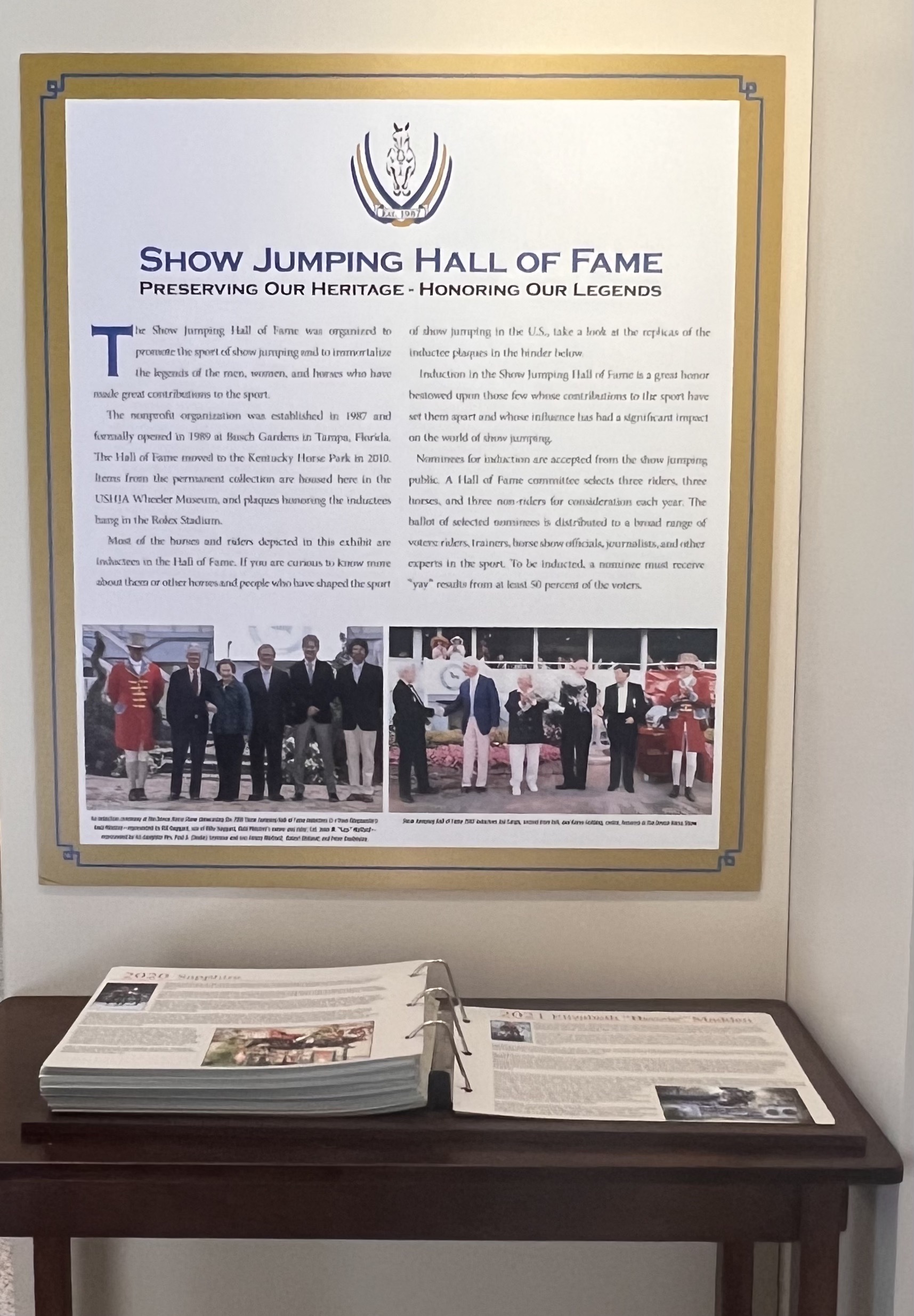 ame's honorary plaques for each inductee can be seen online at showjumpinghalloffame.net.
A binder with replicas of the inductee plaques is on display at the Wheeler Museum in the current exhibit.
The Wheeler Museum is located in the USHJA Headquarters at the Kentucky Horse Park in Lexington, Kentucky. The museum is open to the public Wednesday through Friday from 9:00 a.m. to 4:00 p.m.