
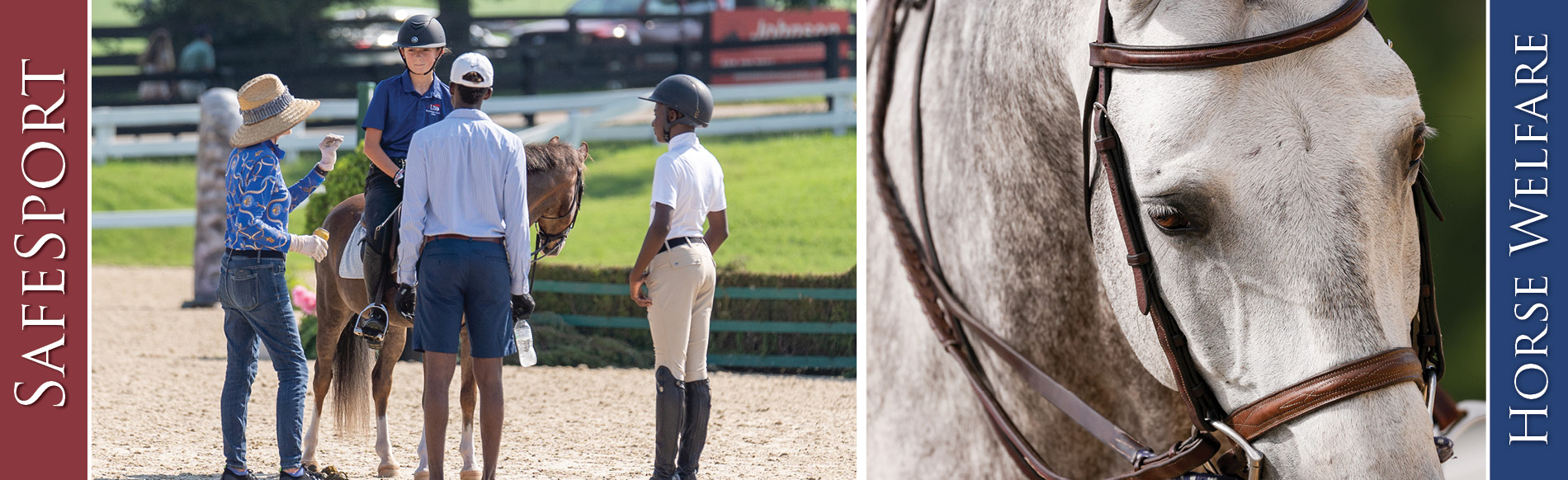
SafeSport
The United States Hunter Jumper Association is committed to the safety and protection of its members and volunteers, as well as the reputation and integrity of the Association. Beyond the safety issues inherent to equestrian activities, we endeavor to teach our members and volunteers how to identify and report behaviors that create an unsafe environment for participants (including bullying, harassment, sexual misconduct, physical misconduct, and emotional misconduct).
Any USEF Competing Member age 18 and over (including amateurs, professionals, juniors who are age 18 and older, and owners who have an annual, three-year, or lifetime membership) and participants at USEF licensed competitions who have regular contact with or authority over minor athletes must take the SafeSport training. Others required by USEF to take the SafeSport training include USEF licensed officials, Chefs d’Equipe, Staff, Board Members, Competition Management, Coaches, Human Physios, Farriers, Trainers, Veterinarians, and Selectors hired or contracted by USEF. The SafeSport training requirement does not apply to USEF Subscriber Members or USEF Competing Members under the age of 18.
In accordance with USHJA Policy GA103, SafeSport training must be completed by USHJA Board and Committee members, USHJA Credentialed Instructors, Chefs d’Equipe, Recognized Riding Academy operators and instructors, and clinicians under a contract of service with USHJA. Additional training, screening, and documentation requirements are outlined in the policy.
About the Courses
The SafeSport Trained Core course helps individuals recognize the signs of abuse, teaches them how to prevent abuse from occurring, and outlines appropriate ways to respond and assist if the abuse has already occurred. Education and awareness will help us create a safe and respectful environment for participants in our sport.
The U.S. Center for SafeSport’s online training course covers three topics in depth:
- Mandatory Reporting
- Sexual Misconduct Awareness Education
- Emotional and Physical Misconduct Education
The course takes approximately 90 minutes to complete, but it is not necessary to complete the training in one sitting – your progress will automatically save as you proceed.
The Core course is supplemented by three Refresher courses. A refresher course must be taken each year following completion of the Core course.
The U.S. Center for SafeSport offers several free courses for parents/guardians and minor athletes. We encourage parents/guardians to take the Parent’s Guide to Misconduct in Sport, a 30-minute training video that educates parents on recognizing, responding to, and preventing abuse and misconduct in your child’s sport setting. This training highlights information and tactics to minimize risks of harm as well as ways to create a safe sport environment for your children. Access tools that help parents and coaches keep young athletes safe are available here.
The U.S. Center for SafeSport also offers courses for minor athletes, with parental consent required for registration. For minors aged 13-17 there is a 15-minute course focused on bullying prevention, supporting friends who have experienced abuse or misconduct, and resources for reporting. For minors aged 5-12 there is a 15-minute course focused on the difference between discipline and abuse, encouraging them to reach out to a trusted adult when something is not right, and stressing the importance of positive sportsmanship and having a healthy sport environment that is focused on fun and safety.
U.S. Center for SafeSport
SafeSport Helpline (24/7 access by phone, online chat, or via app)
The U.S. Center for SafeSport is an independent nonprofit committed to building a sport community where participants can work and learn together free of emotional, physical and sexual abuse and misconduct.
Minor Athlete Abuse Prevention Policies (MAAPP)
MAAPP limits one-on-one adult/minor interactions and sets standards for training and sport settings that prevent abuse and misconduct.
U.S. Department of Health & Human Services
The Department of Health & Human Services provides information on the laws in each state regarding the reporting of child abuse.
USEF SafeSport Reporting Resources
USEF SafeSport FAQ
USEF SafeSport Policy
Informational Booklets
- For Parents of Preschool Children
- For Parents of School-Age Children
- For Parents of Middle School Youth
- For Parents of High-School-Aged Adolescents
- Parent Tool Kit – All Ages
Guides
Horse Welfare
This information is designed to help equestrians be the best partners for their horses.
Equine Basic Needs
To do what is best for our horses, we must first know what makes a horse happy and comfortable in their environment. Anything differing from what is natural must be considered and applied in a thoughtful, knowledgeable way with horses’ well-being in mind.
Horses in their natural state were social herd animals who roamed, grazed, and relied on fight-or-flight to stay alive. As horses have become domesticated, humans have changed their entire way of life, so it’s up to us to ensure we are meeting their physical, physiological, and mental needs.
- At minimum, horses need water and food to survive. Horses need to drink 10-12 gallons of fresh, clean water per day to stay hydrated in average temperatures.
- Though their digestive systems do best with free-choice forage, grain meals are often the norm. If possible, break up grain meals into multiple smaller meals throughout the day and offer high-quality hay for the fiber necessary for a healthy gut.
- Horses are herd animals and most often thrive with ample turnout with a buddy or a group. Confining horses to a stall and limiting turnout time can lead to an increase in stress, digestive issues, ulcers, stable vices, and pent-up energy, leading to unwanted behavior in hand or under saddle. Whether at home or at competition, strive to provide ample time outside of the stall that doesn’t require work. Hand grazing or hand walking several times a day is recommended when turnout isn’t available.
- Routine care such as vaccinations, deworming, hoof, and oral care.
Signs of a happy, healthy horse include:
- Bright eyes
- Good appetite
- Clean legs
- Soft, swiveling ears
- In good weight
- Sleek, shiny coat
- Sound movement
- Normal gut sounds
- Healthy hooves
- Well-hydrated
- Pink gums
- Well-formed manure
- Clear urine
- Relaxed nostrils
- Willing attitude
Do you know the normal range of a horse’s vital signs?
- Temperature: 99.0-101.5°F
- Heart rate: 28-40 beats/minute
- Respiration rate: 12-16 breaths/minute
Click to view USEF’s “A Good Life for Horses”
Know Your Horse and Be Involved
It takes a team to care for your horse. At minimum, you and your horse should have a regular relationship with a veterinarian and farrier, but other professionals such as a trainer, chiropractor, dentist, saddle fitter, massage therapist, or other practitioners may be enlisted to help ensure your horse feels and performs at their best.
Many owners cannot oversee their horse 24/7 and rely on a “team” to help ensure their health and safety throughout the day. Utilizing a stall card helps ensure that your horse receives proper care even when you are not around.
When at home, post on your stall:
- The horse’s name
- Trainer or barn manager’s name and phone number(s
- Your name and phone number(s)
- Your vet’s name and phone number(s
Stall cards can also include notes referencing more personalized information about your horse as an individual. Consider including any of the following:
- Feeding instructions
- Special directions such as wetting hay before feeding, using a hay net, no treats, etc
- Biting, kicking, or cribbing
- Allergies to medications, grains, or treat
Discuss your horses’ training needs, turnout regimen, exercise, and competition schedule so you can be an informed and active participant in their career.
Talk directly with your horse’s vet and trainer to know what your horse’s needs are. Communicate openly with them about medications, treatments, and supplements.
Often a horse’s care is left largely up to the trainer who manages nearly all aspects of their training, show, and daily care. In these instances, it is imperative to work closely with trainers to stay apprised of care, including their feeding regimen, medications given, training techniques, or show schedule, including training, schooling, and longeing plans. While we expect and assume that our horse’s team is looking out for their well-being, ultimately it is the owner’s responsibility to ensure a horse is treated properly and receiving the best care possible.
Be Knowledgeable of Welfare Rules
It is the responsibility of trainers, owners, and riders to be knowledgeable of the USEF welfare rules. Adhere to these rules at competitions, but also at home, and review them regularly so you are always aware of updates. Horse welfare rules can be found in the General Rules chapter 8 as well as within each of the discipline chapters.
Talk with your trainer if something doesn’t sit right with you or is not in line with USEF’s rules.
Drugs and Medications
Training with Horse Welfare in Mind
Sometimes horses are treated poorly through unintentional actions. This may include unknowingly using outdated training techniques or improperly using equipment, having a lack of understanding of the USEF rules, or not being fully involved in the care of your horse. But when we know better, we must do better. The best way to recognize when a piece of equipment or training technique is abusive to the horse is knowing and understanding how they should be implemented appropriately.
See USEF GR838 Unethical Treatment of the Horse.
Riding and training a horse using a reward system is one of the fundamental elements of the American Hunter/Jumper System. Using the aids properly involves a systematic application of discipline (any active aid or correction) and reward (immediate relaxation of the aid or correction). When applying one aid, another must be relaxed in order for the horse to understand and respond.
Emotion can never be involved when applying an aid. Praise, however, is always appropriate for any amount of try or attempt made by the horse and at the end of an exercise or schooling session.
Artificial Aids
Artificial aids are an extension of natural aids, and their use can be both helpful and hurtful.
- Spurs- A poorly fitted or placed spur, spurs used too strongly, too often, out of frustration, or an uneducated leg armed with even the shortest of spurs can cause discomfort or injury to the horse. Riding a horse with an active spur mark is inappropriate.
- Whips- The use of the whip should be applied incrementally and only to support the incremental use of the natural aids. USEF rules limit the size of bats, crops, or whips to 30” when jumping or schooling over fences. The whip should never be used out of frustration or anger. Horses should never be hit on the head or face with a whip, and hitting a horse overhand is not appropriate.
Horses have a thin layer of sensitive muscle below the skin that contracts rapidly when stimulated by touch. This reaction is a visual representation of just how sensitive a horse is to touch. Aids like whips and spurs, wrinkles in a saddle pad, and pressure points from tack are felt exponentially because of this sensitive feature, so ensuring thoughtful use of the aids and correct fit of equipment can drastically affect a horse’s well-being when in work.
Hyperflexion
Some training devices and/or improper training techniques that force a horse’s head and neck into an unnatural position can be detrimental. Hyperflexion, often called rollkur, forcefully creates a false headset and causes damage to the spine, affects breathing, increases stress, and is a horse welfare concern. (Consider defining as “behind the vertical.”)
Longeing
When done properly, longeing can be an excellent way of training and exercising both horse and rider. Done improperly, longeing can damage the horse’s heart, lungs, legs, or mind, lead to bad habits, and do more harm than good.
Longeing may be of benefit to the horse in the following ways:
- To teach cooperation
- To develop rhythm, balance, and suppleness
- To teach a rider without interfering with the horse
- To train a horse to voice commands
- To diagnose lameness
Some longeing practices can be detrimental to your horse’s well-being. Longeing a horse too long, too hard, or on a circle that is too small can place undue stress on the horse’s body.
- Longeing should never be used as a means of exhausting a horse into submission before a ride.
- Longeing is not a means of punishment.
- Longeing puts lateral stress on a horse’s legs so young, immature horses are especially at risk of injury.
- Chasing a horse around the circle at a gallop or in a disunited canter can cause them to lose their footing and injure itself.
- Longeing for extensive periods of time is inappropriate. It increases their fitness level, which then calls for increasing their longeing time to achieve the same results.
When longeing at a competition, the horse or handler must wear the horse’s competition number.
Check out the longeing videos offered in both English and Spanish to learn more about longeing technique.
Environment and Weather Concerns
Riding in high heat or humidity can cause heat-related stress for both horse and rider. Heat stress occurs when you or your horse’s temperature is too high, hindering the body’s ability to cool itself. Profuse sweating, panting, increased heart rate, lethargy, dehydration, heat stroke, or even death can result.
To help determine if it may be too hot to ride, follow the rule of 150: add the ambient temperature to the humidity. If the total is greater than 150, your horse loses the ability to cool itself effectively and they can be at risk for heat stress or exhaustion. Consider:
- Finding ways to ride in the mornings or evenings when it's cooler out and avoiding exercising in the heat of the middle of the day. This may mean scratching from a class if it's scheduled during the hottest part of the day
- Offering lots of drink breaks (never limit access to water)
- Utilizing shady areas when possible
- Cold hosing to help keep them cool, comfortable, and safe
The rule of 150 pertains to horse trailering as well. Temperatures inside a horse trailer are even warmer than the outside temperature so it’s imperative that you take steps to avoid trailering in the heat.
High temps also affect air quality, making it harder to breathe. The air quality index provides a color-coded indicator of high-risk air quality that can pose additional challenges for people or horses with breathing difficulties. Be aware of the air quality in areas of high heat or air pollutants so you can determine if riding or showing should be postponed.
Smart Show Scheduling
One way to prioritize horse welfare is to take into consideration your competition schedule and actions you can take to ensure your horse is safe, happy, and healthy while showing.
- When planning your show calendar, work with your trainer to map out personal goals for you and your horse.
- Then, research available shows, venues, and divisions or classes that align with your goals.
- Next, take into consideration details such as distance, stall size, type, footing, weather, and other elements that will have a direct and indirect effect on your horse’s well-being while at the show.
- Prioritize the shows that allow you to put your horse first.
When deciding on which classes to enter, ask yourself how much showing is too much showing? While there is no one right answer, it is important to keep in mind that horses are sentient beings, not machines, and you should balance your show calendar and classes entered on your horse as an individual.
Keep in mind that for every over fences class at a competition, the average horse may jump between 8 and 20 jumps. Multiply those times the number of classes per day, and then by week, and the numbers really add up. Overexertion on our horse’s body can lead to injury and a shorter competition career.
Take into account factors such as age, experience, and fitness level of your horse, jump height, weather, footing quality, schooling sessions, and personal goals when planning your competition schedule. Also, careful preparation before a class and proper aftercare can help protect their joints and soft tissues. While every situation varies, it’s in your horse’s best interest to keep practice fences and classes to the fewest necessary to accomplish your goals and help keep your horse happy and healthy for more years to come.
Giving your Horse a Good Life at a Horse Show
- Limit the amount of time your horse is tied in the stall.
- Ensure your horse has access to clean, fresh water at all times.
- Try to keep to your horse’s usual feeding schedule.
- Limit the amount of time your horse stands ringside.
- If your horse wears a fake tail, make sure it's non-weighted.
- Communicate with the braider to coordinate braiding with showing; the goal of having your horse braided for only the necessary amount of time.
- Consider carefully whether to pull shoes for an under-saddle.
Horses are the heart of our sport, and we strive to give them the very best so they can be their greatest in the show ring, on a hack, and as loyal companions.
Whether at home or at the competition grounds, everyone should strive to be the best partners for our horses. Occasionally, we may observe behavior contradicting the respect and care that horses deserve. Whether this stems from a lack of education or unsportsmanlike conduct, we must serve as partners on behalf of all horses. Any action appearing unsafe, a possible violation of the USEF rules, or generally unsettling should be addressed and can be reported so action can be taken to help educate the individual on how to better handle the situation; we must not only adhere to the rules and safety guidelines ourselves, but also promise not to turn a blind eye to safety concerns or inappropriate behavior on the part of others.
For further reading on related topics, visit USEF Horse Welfare and USHJA Resources.
How Can You Help?